For the first three billion years of Earth’s biological chronology, life remained almost exclusively microscopic, unicellular, and marine — an endless expanse of cyanobacterial mats, simple prokaryotes, and primitive microbial ecosystems. Even the emergence of the enigmatic, frond-like Ediacaran biota in the late Neoproterozoic presented soft, quilted organisms that largely lacked active digestive systems, predatory jaws, mineralized skeletons, or bilateral symmetry. Then, approximately 541 million years ago, at the dawn of the Cambrian Period, the geological record underwent the most profound, rapid, and consequential biological transformation in planetary history: the Cambrian Explosion. Within an astonishingly brief geological window of barely 20 to 25 million years, virtually every modern animal phylum — from arthropods and mollusks to echinoderms and our own chordate ancestors — exploded into evolutionary existence.
Executive Takeaway: The Metazoan Big Bang
The Cambrian Explosion (~541 to 514 Ma) represents the rapid evolutionary radiation of complex bilaterian animals. It marked the simultaneous invention of active macropredation, compound vision, hard biomineralized exoskeletons, complex tiered burrowing, and modern trophic food webs. Triggered by escalating ocean oxygenation, calcium chemistry shifts, and developmental genetic breakthroughs (Hox genes), the Cambrian established the anatomical blueprint of all complex animal life on Earth.
The Evolutionary Leap: From Ediacaran Quilts to Bilaterian Engines
To appreciate the magnitude of the Cambrian radiation, one must examine the world that preceded it. During the preceding Ediacaran Period (635 to 541 Ma), marine seafloors were blanketed by organic microbial mats upon which rested the “Ediacara biota” — enigmatic organisms like Dickinsonia, Charnia, and Spriggina. These creatures were largely sessile or slow-gliding, lacking eyes, guts, mouthparts, or mineralized shells, absorbing nutrients passively through thin cellular walls in a tranquil marine regime paleontologist Adolf Seilacher coined the “Garden of Ediacara.”
The boundary between the Ediacaran and Cambrian (the 541 Ma boundary marker Treptichnus pedum) marks the catastrophic end of this tranquil world. In the Early Cambrian, animals suddenly began digging deep, three-dimensional branched burrows into the sediment, tearing up the ancient microbial mats — an ecological revolution known as the Agronomic Revolution (or the Cambrian Substrate Revolution). Seafloors shifted from impermeable organic carpets into soft, oxygenated, three-dimensional ecosystems.
| Evolutionary Feature | Late Neoproterozoic (Ediacaran Biota) | Early-to-Middle Cambrian (Metazoan Explosion) |
|---|---|---|
| Primary Symmetry | Fractal, radial, or glide-reflection (‘quilted’) | True Bilateral Symmetry (Bilateria: Anterior/Posterior & Dorsal/Ventral) |
| Integument & Skeleton | Soft, hydrostatically supported tissues; zero shells | Hard biomineralized skeletons (calcite, aragonite, calcium phosphate) |
| Locomotion & Ecology | Sessile anchoring, passive benthic resting | Active swimming (nekton), burrowing (infauna), hunting (macropredators) |
| Sensory Organs | Primitive chemical reception; zero true eyes | Sophisticated optical compound eyes (e.g. Anomalocaris with 16,000 lenses) |
| Digestive Architecture | Absorption, blind-sac cavities | Through-gut (mouth, pharynx, stomach, intestine, and distinct anus) |
| Animal Phyla Present | Stem metazoans; taxonomic affinity heavily debated | Virtually all modern phyla: Arthropoda, Mollusca, Chordata, Echinodermata, Annelida |
The Environmental and Geochemical Triggers
What triggered this sudden volcanic burst of evolutionary speciation after billions of years of microbial stasis? Geobiologists agree that the Cambrian Explosion was driven by a synergistic convergence of geochemical, environmental, and genetic catalysts:
1. The Oxygen Threshold
Synthesizing hard structural proteins like collagen and powering high-energy muscular locomotion requires immense amounts of cellular oxygen. Throughout the Proterozoic, atmospheric oxygen hovered between 1 and 5 percent of modern levels — sufficient only for millimeter-thin organisms. Following the global “Snowball Earth” glaciations and grand tectonic uplift events, atmospheric and oceanic oxygen levels surged past a critical biological threshold (approximately 10 to 15 percent of present levels), permitting large, thick, hyper-active animals to respire efficiently.
2. The Biomineralization Revolution
During the earliest Cambrian (the Fortunian stage), marine strata worldwide become packed with microscopic cones, tubes, spicules, and scale armor known as the Small Shelly Fauna (SSF) (such as Cloudina and Anabarites). Continental weathering from tectonic collisions washed colossal quantities of dissolved calcium, phosphate, and carbonate ions into global shallow seas. Animals evolved the biochemical machinery to pump these toxic excess calcium ions out of their cells by precipitating them into hard calcium carbonate and calcium phosphate crystals — turning metabolic waste into impenetrable defensive armor.
3. The Hox Gene Tool-Kit
On the molecular genetics front, early bilaterian animals evolved the Hox gene cluster — the master developmental regulatory genes that dictate anterior-to-posterior body patterning, limb segmentation, and organ positioning in embryonic development. With the Hox toolkit in place, evolution gained a modular genetic architecture: by simply dialing the expression timing and spatial gradient of Hox genes up or down, evolution could rapidly sculpt endless variations of segmented legs, antennae, claws, and eyes without inventing new proteins from scratch.
The Invention of Predation and the “Light Switch” Hypothesis
The evolutionary catalyst that supercharged the Cambrian radiation was the invention of active macropredation. In 2003, British zoologist Andrew Parker proposed the “Light Switch” Hypothesis, demonstrating that the evolution of true optical vision (compound eyes in stem-arthropods like Anomalocaris) revolutionized marine ecology overnight.
Before vision, ancient ecosystems were dark; animals interacted via slow diffusion of chemical scents or tactile vibrations. When predators evolved sophisticated compound eyes capable of detecting movement and light from yards away, the oceans became transparent and deadly. This sparked the first great evolutionary arms race in history:
- Predator Weapons: Grasping claws, circular slicing jaws, high-speed swimming appendages, and binocular depth perception.
- Prey Defenses: Impenetrable mineralized calcite shells, sharp dorsal spines, camouflage crypsis, deep infaunal burrowing, and blindingly fast escape tail-flips.
From Trilobites to Our Ancient Ancestor: Pikaia
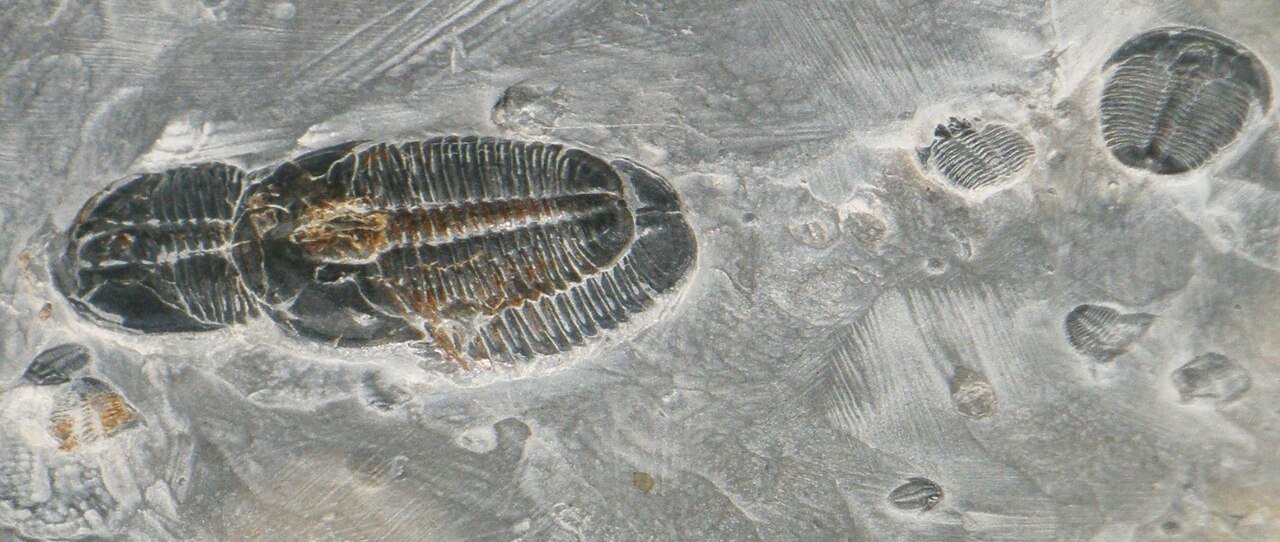
The Cambrian seas were dominated by the Trilobites — iconic arthropods whose calcified, three-lobed dorsal carapaces and crystal calcite compound eyes allowed them to conquer every benthic marine niche for the next 270 million years. Yet nestled alongside the armored trilobites in the Burgess Shale was a humble, two-inch swimming creature: Pikaia gracilens.
Pikaia possessed no teeth, no claws, and no shell. What it possessed, however, was a flexible, stiffened rod of cartilage running down its dorsal midline — a notochord — flanked by chevron-shaped V-shaped muscle blocks (myomeres). Pikaia was one of the earliest known stem-chordates. From that modest, worm-like swimmer in Cambrian muds evolved every fish, amphibian, reptile, dinosaur, bird, mammal, and human that ever walked the Earth.
Conclusion: The Foundation of the Modern Biosphere
The Cambrian Explosion was not a chaotic random scramble; it was the definitive architectural framing of animal life on Earth. In an eye-blink of geological time, natural selection tested, refined, and established the basic bilaterian body templates that govern biology today. Every skeletal jaw that strikes, every eye that gazes, and every segmented limb that walks traces its ancestry directly back to the explosive, vibrant sunlit seas of the Cambrian dawn.