EARTH SCIENCE ARCHIVE / FOSSIL FORMATION
From Ancient Bones to Stone: The Science of Fossilization
Discover how burial, groundwater, mineral chemistry, and geological processes can preserve the remains of ancient animals for millions of years.
When an animal dies, its bones usually do not become fossils. Most remains are scattered by scavengers, broken apart by weather, or gradually decomposed through natural biological and chemical processes.
Yet under unusual conditions, bones can survive long enough to enter the geological record.
Millions of years later, paleontologists may uncover those remains as fossils embedded within layers of rock.
Fossilization is the collection of processes through which evidence of ancient life becomes preserved in geological materials. For bones, this often involves rapid burial, changes in groundwater chemistry, mineral deposition, and long periods of geological alteration.
The process is more complicated than simply waiting for a bone to turn into stone.
Some fossil bones retain portions of their original mineral material. Others contain additional minerals deposited within microscopic spaces, while some undergo substantial chemical replacement.
Understanding these processes helps scientists explain why fossils are rare, how ancient skeletons survive, and what preserved bones can reveal about prehistoric life.
Why Most Animal Bones Never Become Fossils
Fossilization begins with a difficult challenge: preserving biological remains before they disappear.
After death, an animal’s body becomes part of the surrounding ecosystem.
Scavengers may consume soft tissues and move bones away from the original location.
Bacteria and fungi contribute to decomposition, while sunlight, temperature changes, and flowing water can damage exposed skeletal material.
Bones contain both mineral components and organic materials, including collagen.
Over time, these components may break down or dissolve depending on environmental conditions.
Even large, durable bones can eventually fragment and disappear.
For fossilization to occur, the remains generally need conditions that slow destruction and favor long-term preservation.
Burial is often one of the most important factors.
Stage One: Burial Protects the Bones
Imagine a large prehistoric animal dying near a river.
Its remains may initially rest on the ground, exposed to weather and scavengers.
During a flood, sediment carried by moving water could cover some or all of the skeleton.
This burial may protect the bones from further disturbance.
Sand, mud, silt, and other sediments can accumulate around remains, separating them from conditions at the surface.
Burial does not automatically guarantee preservation.
However, it can reduce physical damage and create conditions in which mineral-rich groundwater interacts with the bones.
Different burial environments produce different preservation outcomes.
River floodplains, lakebeds, coastal deposits, and other sedimentary environments have preserved important vertebrate fossils.
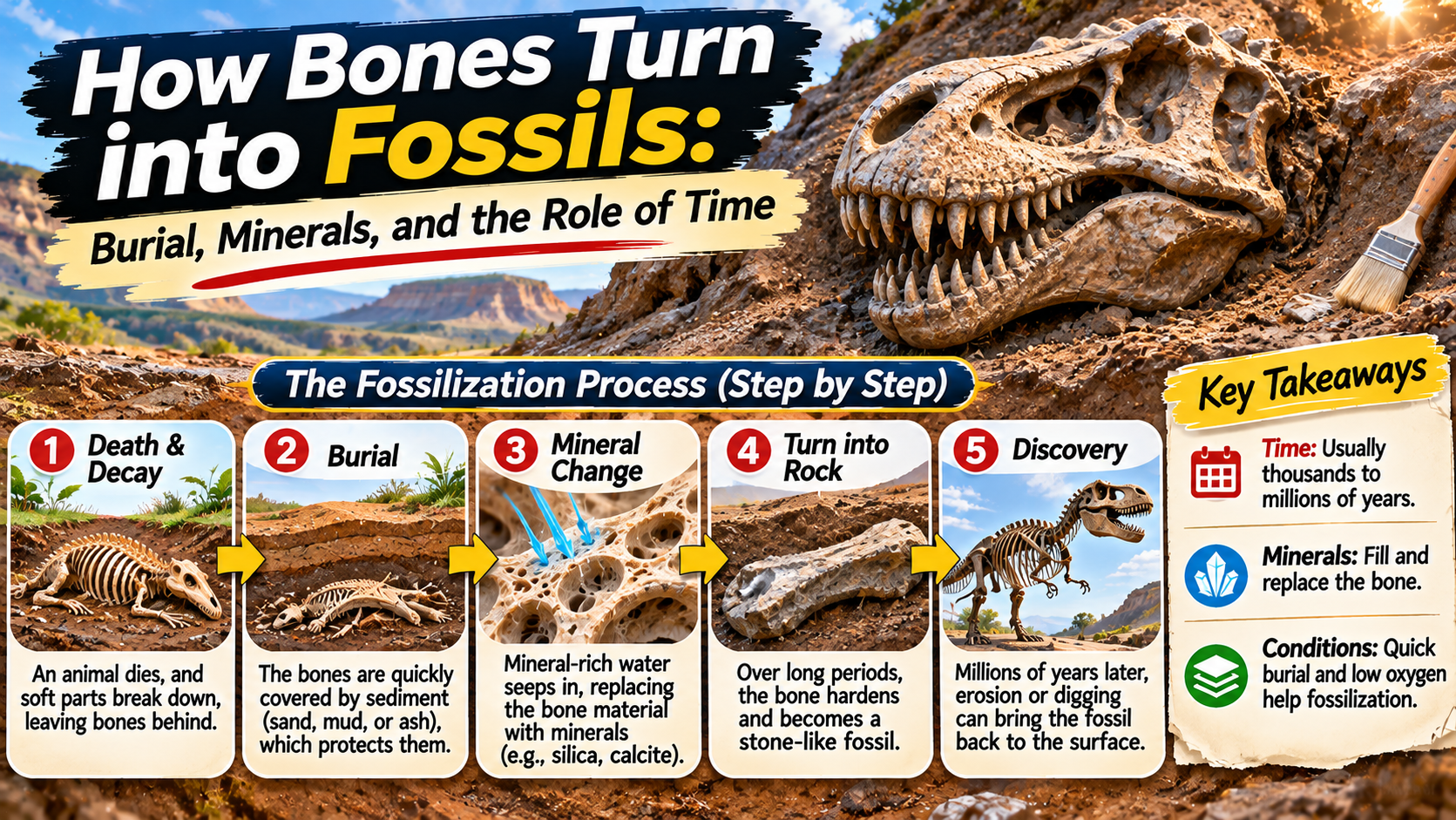
SEDIMENTARY RECORD / FOUR STAGES
An animal dies, and its skeleton begins interacting with the surrounding environment.
Mud, sand, or other material buries the remains and may limit further disturbance.
Dissolved minerals move through pore spaces and may accumulate within the bone.
Sediments may become rock while the buried bones undergo physical and chemical changes.
Stage Two: Groundwater Carries Dissolved Minerals
Once bones are buried, groundwater can become an important influence on their preservation.
Water moving through sediment often contains dissolved substances acquired from surrounding minerals and rocks.
Depending on local conditions, these substances may include silica, calcium carbonate, iron compounds, and other mineral-forming materials.
Bone contains microscopic pores and internal spaces.
Groundwater can enter these spaces and interact with the original skeletal material.
As environmental chemistry changes, dissolved minerals may precipitate from the water and accumulate within the bone.
This process can strengthen the remains and help preserve fine internal structures.
However, groundwater does not always improve preservation.
Under some chemical conditions, it can dissolve bone minerals and contribute to the destruction of the fossil.
The outcome depends on factors such as acidity, temperature, mineral availability, and groundwater movement.
Stage Three: Permineralization Preserves Bone Structure
One of the most important fossilization processes is called permineralization.
During permineralization, minerals carried by groundwater accumulate within the pores and cavities of buried biological material.
Bone is particularly suitable for this process because it already contains a complex internal network of spaces.
As mineral deposits build up, they can preserve microscopic structural details.
The original bone material may remain partly intact while additional minerals fill empty spaces.
For this reason, a permineralized fossil is not necessarily a complete mineral replacement of the original skeleton.
It may contain both original components and minerals introduced after burial.
Permineralization helps explain how some fossil bones preserve internal features that scientists can study using microscopes and imaging technologies.
GEOLOGICAL FIELD NOTE
Permineralization Does Not Mean Every Original Bone Mineral Disappears.
Minerals can fill spaces inside a bone while some of its original mineral structure remains. The degree of alteration varies between fossils and geological environments.
Stage Four: Mineral Replacement Can Change the Bone
Another important process is mineral replacement.
Replacement occurs when original material dissolves and new minerals form in its place.
If replacement happens gradually enough, some aspects of the original structure may remain recognizable.
The resulting fossil can preserve the shape and certain microscopic features of the original bone even though its chemical composition has changed.
Replacement and permineralization are related but distinct processes.
Permineralization involves mineral deposits filling existing spaces.
Replacement involves new minerals taking the place of original material.
Both processes can occur within the same fossil.
Scientists study mineral composition and internal structures to understand the changes that occurred after burial.
What Minerals Are Commonly Found in Fossil Bones?
The mineral composition of fossil bones varies according to the original skeletal material and the surrounding geological environment.
Living vertebrate bone already contains a calcium-phosphate mineral phase related to hydroxyapatite.
During fossilization, this material may undergo chemical alteration.
Other minerals can also accumulate in pores, fractures, or spaces around the remains.
| Mineral or Material | Possible Role in Fossil Preservation |
|---|---|
| Calcium phosphate | Forms the original mineral framework of vertebrate bone and may persist in altered form. |
| Silica | Can precipitate in pores or participate in mineral replacement under suitable conditions. |
| Calcite | May fill cavities and fractures within fossil-bearing deposits. |
| Iron minerals | Can contribute to mineral coatings, staining, and changes in fossil coloration. |
Fossil color alone is not a reliable way to identify its mineral composition.
Two bones from different environments may look similar while containing different secondary minerals.
Laboratory analysis is often needed to determine the exact materials present.
How Sediment Eventually Becomes Rock
As additional layers accumulate above buried remains, the underlying sediment experiences increasing pressure.
Over time, sediment grains may become more tightly packed through compaction.
Minerals precipitating between grains can also bind them together through cementation.
These processes contribute to lithification, the transformation of loose sediment into sedimentary rock.
Fossil bones may become enclosed within sandstone, mudstone, limestone, or other sedimentary deposits.
The type of rock surrounding a fossil can provide information about the environment in which the remains were buried.
For example, some sandstones formed in ancient river systems, while certain fine-grained rocks accumulated in quieter water.
However, rock type alone does not establish a complete environmental history.
Geologists examine sedimentary structures, fossils, mineral composition, and surrounding layers to reconstruct ancient conditions.
The Role of Time in Fossil Formation
Time is essential to understanding fossils, but fossilization does not operate according to a single fixed schedule.
Some mineral changes can begin relatively soon after burial.
Other transformations continue over thousands or millions of years.
The speed of these processes depends on groundwater chemistry, temperature, pressure, sediment conditions, and the original material.
A bone does not need to remain unchanged for millions of years before fossilization can begin.
Instead, preservation and chemical alteration may start early and continue throughout its burial history.
Many dinosaur fossils are tens of millions of years old because dinosaurs lived during the Mesozoic Era.
However, fossils can also be much younger.
Scientists distinguish between the age of a preserved organism and the processes responsible for preserving its remains.
IMPORTANT SCIENTIFIC DISTINCTION
Fossilization Is a Process, Not a Countdown.
There is no universal number of years required for a buried bone to become a fossil. Preservation depends on geological and chemical conditions, and the word “fossil” also involves scientific context rather than a single agreed age threshold.
Why Some Environments Preserve Fossils Better
Certain environments provide conditions more favorable to preservation than others.
Rapid sediment accumulation can protect remains before they are destroyed.
Fine-grained sediment may preserve delicate details under suitable conditions.
Low-oxygen environments can sometimes slow particular forms of decomposition, although they do not prevent all biological or chemical breakdown.
Mineral-rich groundwater may promote permineralization or other preservation processes.
In contrast, acidic conditions can dissolve bone minerals.
Strong currents may transport and damage skeletal remains before burial.
Repeated exposure to weather can also reduce the likelihood of preservation.
This helps explain why the fossil record is incomplete.
It preserves only a fraction of the organisms that once lived on Earth.
How Fossil Bones Return to the Surface
Even after a bone becomes preserved within rock, it may remain hidden underground for millions of years.
Geological processes can eventually bring fossil-bearing layers closer to the surface.
Tectonic activity may uplift sedimentary rocks.
Weathering and erosion can then remove overlying material and expose previously buried layers.
Wind, rainfall, rivers, and temperature changes all contribute to the gradual breakdown of exposed rock.
When erosion reaches a fossil-bearing layer, parts of a bone may become visible.
This exposure creates an opportunity for discovery, but it also places the fossil at risk of further damage.
Paleontologists therefore document fossil locations carefully and use appropriate excavation methods to protect important evidence.
How Paleontologists Study Fossilized Bones
After a fossil is discovered, researchers examine both the preserved remains and their geological surroundings.
The position of the fossil within rock layers helps establish its stratigraphic context.
Scientists may use radiometric dating on suitable associated rocks or minerals to constrain the age of fossil-bearing deposits.
Computed tomography, commonly called CT scanning, can reveal internal structures without requiring the fossil to be cut open.
Microscopic examination may identify bone tissue organization and evidence of growth.
Chemical analysis can reveal changes in mineral composition that occurred during burial.
These methods help researchers distinguish original biological features from alterations produced during fossilization.
That distinction is essential when reconstructing the anatomy and biology of extinct animals.
Do All Fossils Form Through Mineralization?
No. Fossilization includes several preservation pathways.
Some organisms leave impressions or molds in sediment.
Others become preserved as carbon-rich films.
Plant and animal remains may occasionally survive through exceptional preservation conditions, including freezing or entrapment in natural materials.
Trace fossils, such as footprints and burrows, preserve evidence of activity rather than body parts.
Even fossil bones do not all undergo identical chemical transformations.
Some retain substantial portions of their original mineral framework, while others experience extensive alteration.
The diversity of preservation processes is one reason paleontologists study fossils together with their geological context.
Frequently Asked Questions
How do bones become fossils?
Bones may become fossils when they are preserved after burial and undergo physical or chemical changes, including mineral deposition and alteration.
How long does fossilization take?
There is no fixed duration. Mineral changes may begin relatively early, while other geological transformations continue over much longer periods.
Are fossil bones made entirely of stone?
Not always. Some fossil bones retain original mineral components alongside minerals introduced during burial.
What is permineralization?
Permineralization occurs when minerals carried by groundwater accumulate in the pores and cavities of buried biological material.
Why are fossils usually found in sedimentary rocks?
Sedimentary environments can bury and preserve remains without the extreme heat associated with many igneous or metamorphic processes.
Can bones dissolve instead of becoming fossils?
Yes. Groundwater chemistry and environmental conditions can cause bone minerals to dissolve, preventing long-term preservation.
How do scientists determine the age of fossil bones?
Researchers use geological context and appropriate dating techniques. The method depends on the fossil’s age and the materials available for analysis.
Final Thoughts
The transformation of bones into fossils is the result of interacting biological, chemical, and geological processes.
Burial can protect remains from destruction, while groundwater may introduce minerals that fill microscopic spaces or alter original bone material.
As sediments become rock, preserved bones can remain enclosed within geological layers for extraordinary periods.
Later uplift and erosion may expose those fossils, allowing paleontologists to study them.
However, fossilization is never guaranteed, and no single sequence applies to every discovery.
Each fossil reflects the conditions of its original environment and the geological history that followed.
By understanding burial, mineralization, and time, scientists can interpret fossil bones as both biological remains and records of Earth’s changing environments.