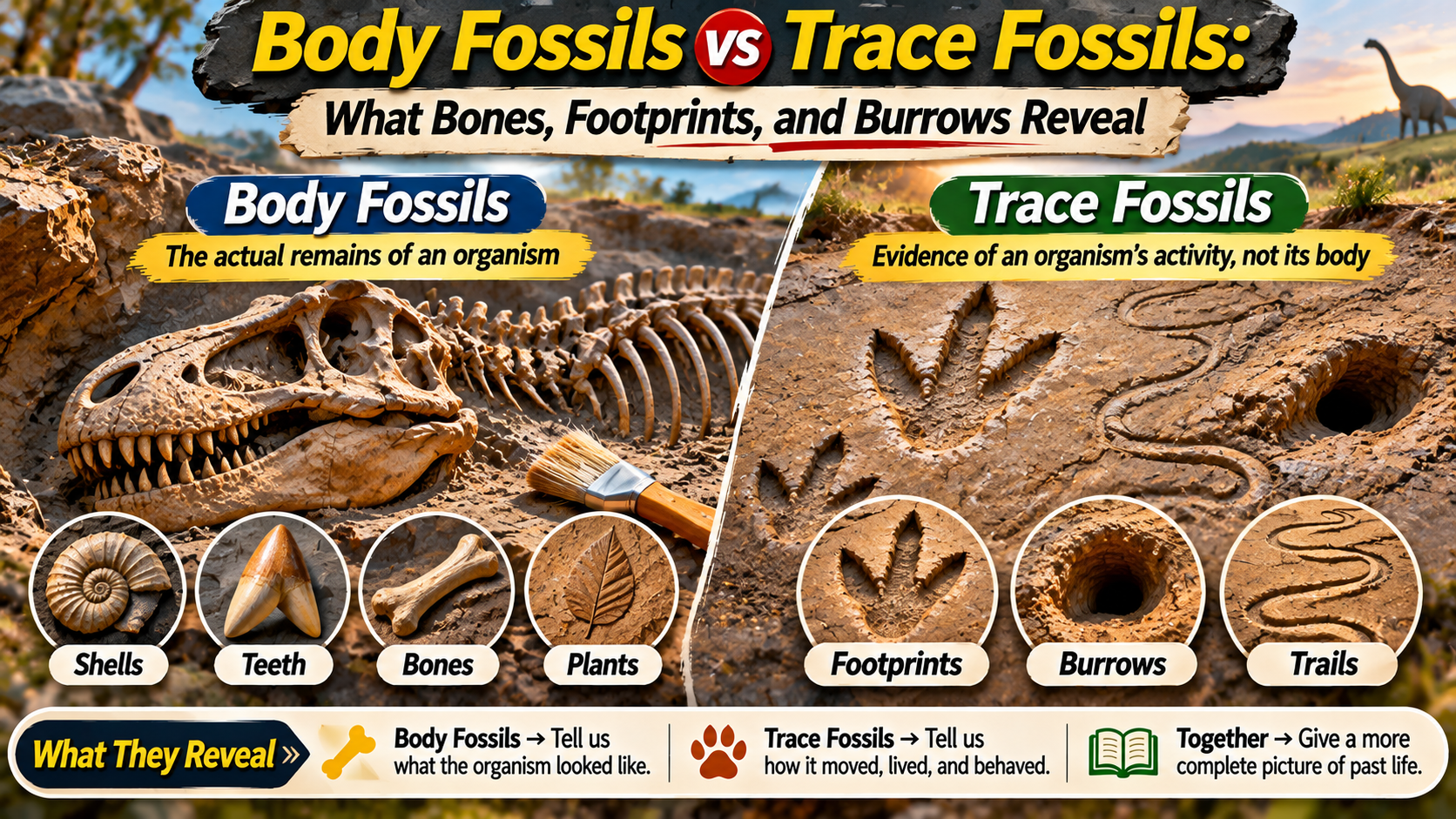
Bones, teeth, shells, and preserved body structures.
Footprints, trails, burrows, and feeding marks.
Anatomical information and behavioral evidence.
Imagine discovering a dinosaur footprint preserved in a layer of ancient rock. Nearby, an excavated fossil skeleton reveals the animal’s bones, teeth, and body structure. Both discoveries provide evidence of prehistoric life, but they answer different scientific questions. The skeleton helps researchers understand the animal’s anatomy, while the footprint reveals something about its movement and interaction with the ground.
This distinction is central to understanding body fossils vs. trace fossils. Although both are products of fossilization and geological preservation, they represent different kinds of evidence. Body fossils preserve parts of organisms themselves, whereas trace fossils record activities performed by living organisms. Studying them together allows paleontologists to build a more complete picture of ancient ecosystems.
1. What Are Body Fossils?
Body fossils are preserved physical remains of ancient organisms. They may include bones, teeth, shells, leaves, wood, scales, and other biological structures. These fossils form when parts of an organism become buried and undergo chemical or physical changes that allow them to survive in the geological record.
Hard body parts are generally more likely to fossilize than soft tissues. Bones and shells contain durable materials that can withstand conditions that would normally destroy delicate organic structures. However, under unusual environmental conditions, soft tissues can also be preserved, sometimes revealing remarkably detailed anatomical information.
Common examples of body fossils
- Bones: Fossilized skeletal remains of dinosaurs, mammals, reptiles, and other vertebrates.
- Teeth: Durable structures that can reveal information about diet, feeding adaptations, and animal identification.
- Shells: Preserved coverings of marine organisms, including mollusks and other shelled animals.
- Fossil wood: Ancient plant material that has undergone mineral replacement or other preservation processes.
- Leaves: Impressions, compressions, or mineralized remains that help reconstruct ancient vegetation.
- Soft-tissue impressions: Unusual preservation of skin outlines, feathers, or other delicate structures.
Why are bones so important?
Skeletal fossils can help researchers estimate an animal’s body size, identify structural adaptations, examine injuries, and compare anatomical relationships between extinct and living species. Nevertheless, a skeleton alone cannot reveal every aspect of an organism’s behavior or appearance.
2. How Body Fossils Become Preserved
Fossil preservation begins with biological remains entering an environment where destruction is limited enough for preservation to occur. After death, an organism may be buried by mud, sand, volcanic ash, or other sediment. Rapid burial can reduce exposure to scavengers, oxygen, weathering, and destructive biological activity.
Over time, additional sediment accumulates above the remains. Pressure increases as these layers become compacted, while groundwater moves through pores and cracks in the sediment. Dissolved minerals can gradually fill spaces within bones or replace original materials. This process is associated with permineralization and mineral replacement.
Not every fossil forms in the same way. Some shells remain chemically recognizable, while others dissolve and leave behind impressions or molds. Plant remains may become flattened into thin carbon-rich films. In exceptional environments, organisms can be preserved through freezing, drying, or entrapment in substances such as tree resin.
The preservation sequence
An organism dies or leaves biological material behind.
Sediment covers the remains.
Minerals and geological processes change the material.
Erosion or excavation exposes the preserved fossil.
This is a simplified illustration. Actual fossilization pathways vary considerably between environments and materials.
3. What Are Trace Fossils?
Trace fossils, also known by the scientific term ichnofossils, preserve evidence of biological activity rather than the actual physical remains of an organism. They record something an animal or other organism did while alive, including walking, crawling, digging, feeding, resting, or moving through sediment.
A footprint is one of the easiest trace fossils to recognize. When an animal walks across soft sediment, its feet can leave impressions. If those impressions are subsequently covered by additional sediment and protected from erosion, they may eventually become preserved in rock.
Burrows are another important category. Animals that dig into sediment can create tunnels and chambers that survive long after the original burrow-maker disappears. These structures may provide evidence of feeding, shelter, protection, or movement through the sediment.
Major types of trace fossils
Impressions made by walking, running, or moving animals.
Tunnels and chambers created within sediment or soil.
Bite marks, scratches, and other evidence of food-related activity.
Impressions left by organisms resting against sediment.
Trace fossils are especially valuable because they can preserve evidence of behavior that is rarely visible in skeletal remains. They may also survive in locations where body fossils are uncommon, giving scientists access to otherwise poorly understood environments.
4. What Dinosaur Footprints Reveal About Movement
Dinosaur footprints are among the most recognizable examples of trace fossils. Individual impressions can reveal the approximate shape and size of an animal’s feet, while connected sequences known as trackways provide information about movement.
Researchers examine footprint length, width, depth, spacing, orientation, and the arrangement of toes. The distance between successive prints can help estimate stride length. When combined with reasonable estimates of leg proportions, trackway measurements may support calculations of possible walking or running speeds.
However, interpreting footprints requires caution. Sediment consistency, moisture, slope, and the animal’s movement can all affect the final shape of an impression. A deep footprint does not automatically mean the animal was exceptionally heavy, because soft sediment can deform more than firm ground.
Trackways can sometimes indicate whether an animal was moving alone or alongside others. Multiple parallel trackways may suggest coordinated movement or animals using the same route. In some cases, researchers investigate whether the tracks are consistent with group travel, although social behavior cannot always be established from footprints alone.
A trackway is not simply a collection of footprints. Its direction, spacing, orientation, and relationship with other tracks can transform individual impressions into evidence about movement across an ancient landscape.
5. What Burrows Reveal About Ancient Ecosystems
Burrow trace fossils provide a different kind of information. Instead of recording movement across a surface, they reveal activity beneath it. Ancient burrows may preserve branching tunnels, vertical shafts, horizontal passages, and complex networks of chambers.
These structures can help paleontologists understand how organisms interacted with sediment. Some animals dug to obtain food, while others created tunnels for protection, shelter, or reproduction. Marine worms, crustaceans, and other invertebrates are responsible for many burrow structures found in sedimentary rocks.
Burrows can also reveal the environmental conditions that existed when sediment was deposited. Their depth, shape, distribution, and preservation may help researchers investigate oxygen availability, sediment consistency, water movement, and the activity of organisms living within the substrate.
In marine environments, burrowing organisms play important ecological roles by mixing sediment and moving organic material. This activity is called bioturbation. Ancient bioturbation patterns can therefore provide evidence about how prehistoric seabeds functioned.
6. Body Fossils vs. Trace Fossils: The Main Differences
Both fossil categories contribute to paleontological research, but their scientific value depends on the questions being investigated. Body fossils provide direct evidence of preserved biological structures, whereas trace fossils record interactions between organisms and their surroundings.
| Comparison | Body Fossils | Trace Fossils |
|---|---|---|
| What is preserved? | Physical remains | Evidence of activity |
| Examples | Bones, teeth, shells | Tracks, burrows, bite marks |
| Main scientific value | Anatomy and structure | Behavior and interaction |
| Organism identification | Often possible from diagnostic features | Often more difficult and indirect |
| Preservation | Burial and alteration of remains | Preservation of impressions or structures |
| Typical research questions | What was the organism like? | What did the organism do? |
One important distinction is that trace fossils are not necessarily evidence of a specific species. A footprint may clearly show a particular type of movement or foot structure without providing enough information to identify the exact animal responsible. Paleontologists therefore classify many trace fossils according to their preserved form and characteristics rather than assigning them directly to a body-fossil species.
7. Why Scientists Study Both Types of Fossils Together
Studying body fossils and trace fossils together creates a more complete understanding of prehistoric organisms. A fossil skeleton might reveal an animal’s approximate size, skeletal structure, and possible feeding adaptations. A nearby footprint could provide additional evidence about how that animal moved across its environment.
For example, fossilized teeth can suggest whether an animal consumed tough plant material, meat, or a varied diet. However, actual feeding traces may offer additional evidence of how organisms interacted with food sources. Similarly, fossilized bones can establish which animals lived in a particular region, while burrows and trackways help reconstruct their ecological surroundings.
Combining these records also helps researchers recognize the limitations of the fossil record. An environment may preserve footprints but very few skeletons, or it may contain abundant shells without clear evidence of animal movement. Using multiple types of evidence reduces dependence on a single incomplete source.
Anatomy, skeletal proportions, teeth, body structures, and possible dietary adaptations.
Movement, feeding activity, burrowing, resting, and interactions with sediment.
Together, these records help researchers reconstruct ancient environments more effectively than either category could independently.
8. Important Limitations in Fossil Interpretation
Although fossils provide valuable evidence, they do not preserve a complete record of prehistoric life. Fossilization is selective. Soft tissues often decay before burial, geological processes can destroy preserved material, and erosion may remove entire fossil-bearing layers.
Trace fossils introduce additional interpretive challenges. Similar footprints may have been produced by different animals, while the same animal can create different impressions under different conditions. A burrow’s shape may suggest a particular activity, but it does not always reveal exactly what the organism was doing.
Scientists address these problems by comparing multiple specimens, examining geological context, studying modern organisms, and testing different explanations against available evidence. They also distinguish observations from interpretations, especially when behavioral conclusions are involved.
Three common misunderstandings
Correction: Fossils include plant remains, shells, impressions, footprints, burrows, and many other forms of preserved evidence.
Correction: Footprints may reveal movement and foot characteristics without identifying an exact species.
Correction: Trace fossils can preserve behavioral information that body fossils rarely provide.
9. How Modern Paleontologists Examine Fossil Evidence
Modern paleontology combines traditional excavation with increasingly sophisticated analytical methods. Researchers document fossil locations, geological layers, surrounding sediment, and relationships between specimens before removing material. This contextual information is essential because a fossil’s scientific meaning depends partly on where and how it was preserved.
For body fossils, techniques such as CT scanning can reveal internal structures without requiring researchers to physically expose every part of a specimen. Microscopy and chemical analysis may provide further information about mineral composition, surface details, and preservation history.
Trace fossils are examined through careful mapping, photography, three-dimensional surface recording, and sediment analysis. Researchers may use digital models to measure footprints or compare the geometry of ancient burrows. Modern animal movement and burrowing behavior can also provide useful comparisons, although living species are not exact substitutes for extinct organisms.
These approaches demonstrate that paleontology is not simply about collecting ancient objects. It is a scientific process that combines geology, biology, anatomy, chemistry, and comparative research to interpret evidence responsibly.
10. Frequently Asked Questions
1. Can footprints be considered fossils?
Yes. Footprints can become trace fossils when impressions left by organisms are buried, preserved, and eventually incorporated into sedimentary rock. They provide evidence of movement and activity rather than physical body parts.
2. Are teeth body fossils?
Yes. Teeth are biological structures belonging to an organism, so preserved teeth are classified as body fossils. Their shape, wear patterns, and microscopic features can provide clues about feeding adaptations and diet.
3. What is the difference between a footprint and a trackway?
A footprint is an individual impression left by an organism. A trackway is a sequence of footprints that records movement across a surface. Trackways can provide additional information about stride length, direction, and possible movement patterns.
4. Can trace fossils reveal animal behavior?
Yes. Footprints, burrows, feeding marks, and resting impressions can preserve evidence of activities. However, researchers must interpret these traces carefully because a single structure may have more than one possible explanation.
5. Can trace fossils be found without body fossils?
Yes. Trace fossils can occur in sedimentary deposits where the organisms’ physical remains were never preserved or have not been discovered. This makes them particularly valuable for studying environments with limited body-fossil evidence.
6. What is ichnology?
Ichnology is the scientific study of traces made by organisms, including both modern biological traces and fossilized evidence. The study of fossil traces is an important part of paleontological research.
7. Which type of fossil is more important?
Neither category is universally more important. Body fossils are especially useful for understanding anatomy, while trace fossils help reconstruct behavior and environmental interactions. Their value depends on the scientific question being investigated.
The Evidence Left Behind by Ancient Life
The distinction between body fossils and trace fossils reveals why prehistoric research depends on more than bones and skeletons. Physical remains provide important information about the structures of extinct organisms, while footprints, burrows, and feeding marks preserve evidence of how ancient life interacted with its surroundings.
Neither category tells the entire story on its own. A fossilized tooth cannot describe every movement of an animal, and a footprint cannot always identify the exact species that created it. When researchers combine anatomical evidence with preserved activity, however, they can reconstruct ancient ecosystems with greater depth and scientific confidence. These two forms of fossil evidence turn fragments of the geological record into meaningful insights about life on Earth.
Bones reveal the structures of ancient life. Footprints and burrows reveal the activities that shaped its world.
Understanding both is essential to reading the fossil record as evidence of living ecosystems rather than simply a collection of preserved objects.