PALEONTOLOGY FIELD JOURNAL / FOSSIL EVIDENCE
Ancient Footprints, Living Movements: Reading the Dinosaur Fossil Record
A dinosaur’s bones reveal its anatomy. Its footprints can reveal how it actually moved across an ancient landscape.
Millions of years after dinosaurs disappeared, their footprints continue to preserve remarkable evidence of how they lived. Some fossil tracks record a single step, while others form long trails that reveal the direction, spacing, and rhythm of an animal’s movement.
These preserved sequences are called fossil trackways, and they provide paleontologists with a different kind of evidence from fossilized bones.
A skeleton can reveal the structure of an animal’s legs, hips, and feet. A trackway, however, captures the interaction between a moving dinosaur and the ground beneath it.
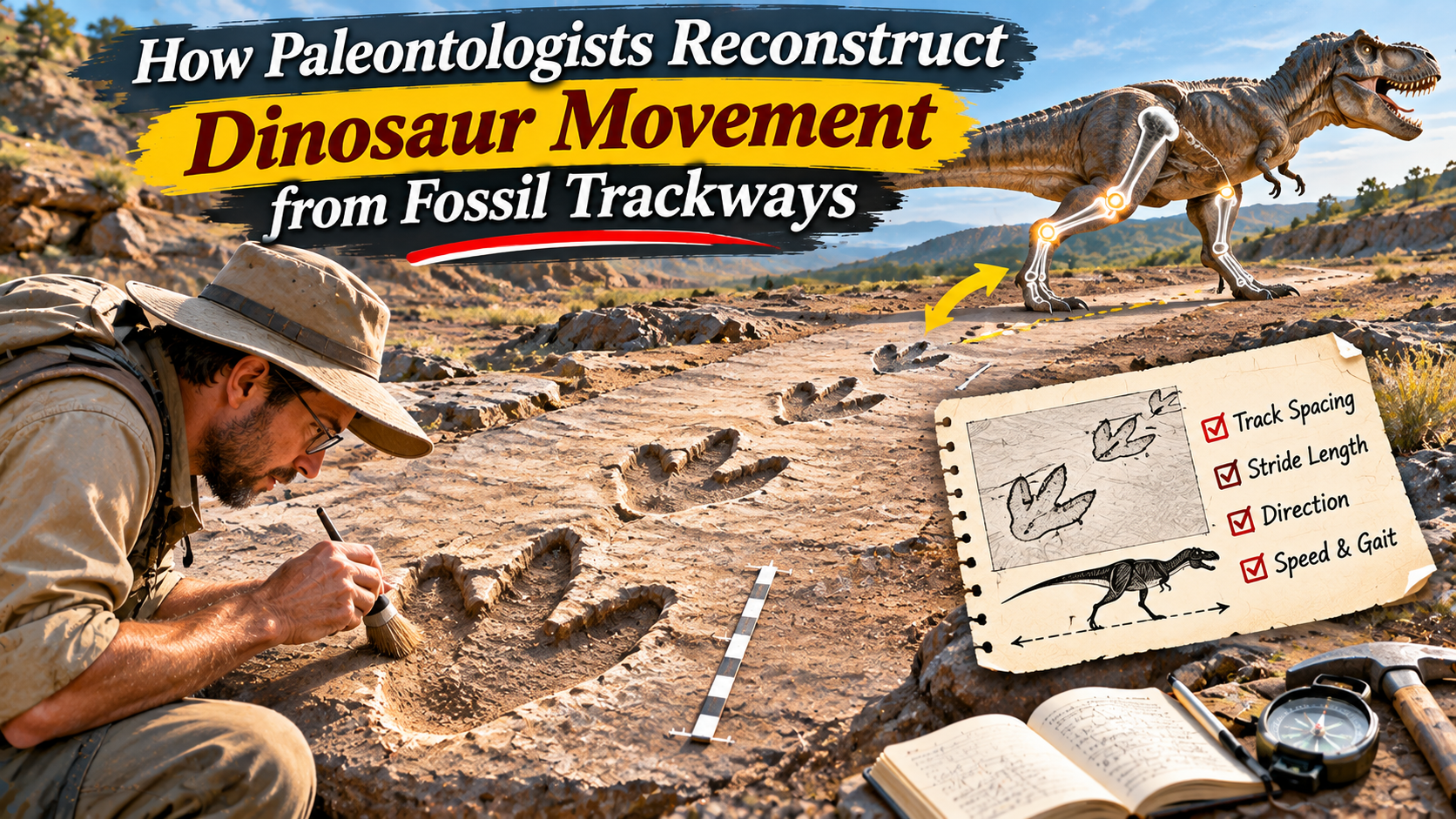
By measuring footprints, examining stride patterns, studying sediment deformation, and comparing fossil evidence with modern animals, researchers can estimate how dinosaurs walked, turned, and sometimes moved at higher speeds.
These conclusions require careful interpretation. A footprint does not preserve every detail of a dinosaur’s behavior, and different conditions can produce similar-looking tracks.
Nevertheless, fossil trackways remain among the most valuable sources of information about dinosaur locomotion.
What Are Dinosaur Fossil Trackways?
A fossil trackway is a sequence of footprints left by an animal moving across a surface that later became preserved in the geological record.
During the Mesozoic Era, dinosaurs walked across riverbanks, muddy floodplains, lake margins, coastal environments, and other landscapes.
When the ground had suitable moisture and consistency, their feet created impressions in the sediment.
Some of these impressions were subsequently buried beneath additional sediment layers.
Over geological time, the sediments could become rock, preserving the footprints as trace fossils.
Unlike body fossils, which include bones and teeth, trace fossils record evidence of an organism’s activity.
The scientific study of traces such as footprints, burrows, and feeding marks is known as ichnology.
Trackways are especially useful because they preserve multiple steps rather than an isolated footprint.
The sequence allows scientists to examine patterns of movement across a surface.
How Dinosaur Footprints Become Fossils
Not every dinosaur footprint had the right conditions to survive.
Preservation depended on several environmental factors, including sediment texture, moisture, burial, and later geological changes.
FIELD PROCESS / FOOTPRINT PRESERVATION
A dinosaur steps onto soft sediment, creating an impression through the pressure of its foot.
The impression remains intact long enough to avoid complete destruction by water, weather, or other animals.
New sediment covers the footprint, potentially protecting it from erosion.
Sediments become rock, and later erosion or excavation may expose the preserved track.
Some tracks preserve detailed toe impressions and claw marks. Others show only broad depressions.
Researchers must also distinguish true surface footprints from impressions transmitted into deeper sediment layers, known as undertracks.
These differences matter because the shape of a fossil footprint may not perfectly represent the anatomy of the animal’s foot.
The Measurements That Reveal Dinosaur Movement
When paleontologists discover a trackway, they begin by documenting its geometry.
Careful measurements help researchers describe how the animal placed its feet and moved along the track-bearing surface.
Footprint Length and Width
Footprint dimensions provide clues about the size and shape of the dinosaur’s feet.
However, soft sediment can distort impressions, so footprint size does not translate directly into an exact body measurement.
Step Length
Step length generally describes the distance between successive footprints made by alternating feet.
It helps researchers understand the spacing of the animal’s steps.
Stride Length
Stride length is the distance between consecutive footprints made by the same foot.
It is particularly useful when estimating locomotion speed and examining gait.
Trackway Width
Trackway width describes the lateral spacing of footprints relative to the direction of travel.
This measurement can provide information about stance and limb positioning.
Footprint Orientation
The direction in which footprints point can reveal how the feet were positioned during movement.
Researchers also examine changes in orientation when an animal turned or changed direction.
| Measurement | What It Helps Scientists Study |
|---|---|
| Footprint dimensions | Foot size, morphology, and possible trackmaker characteristics |
| Step length | Spacing between alternating foot placements |
| Stride length | Gait patterns and estimated movement speed |
| Trackway width | Stance and relative foot placement |
| Footprint direction | Travel direction and changes in movement |
How Scientists Estimate Dinosaur Walking Speed
One of the most interesting applications of fossil trackways is estimating how quickly a dinosaur moved.
Researchers can combine stride length with an estimate of the animal’s hip height to study locomotion.
Hip height is often estimated from footprint dimensions using relationships developed from dinosaur anatomy and comparative evidence.
Scientists then apply biomechanical models that relate stride length, leg dimensions, and movement speed.
A widely known approach builds on research by zoologist R. McNeill Alexander, who examined relationships between animal movement and trackway measurements.
The underlying idea is that animals moving at different speeds tend to show different relationships between stride length and leg length.
However, these estimates are not direct measurements of speed.
They depend on assumptions about body proportions, gait, and the applicability of models developed from living animals.
Consequently, paleontologists usually treat calculated speeds as approximate values rather than exact results.
RESEARCH NOTE / SPEED ESTIMATION
Longer Strides Can Suggest Faster Movement—but Context Matters.
Stride length must be considered relative to estimated leg length. Sediment conditions, body proportions, and uncertainty in the trackmaker’s identity can all influence the interpretation.
Can Footprints Reveal Whether a Dinosaur Was Running?
Some fossil trackways suggest movement substantially faster than an ordinary walk.
Long strides relative to estimated hip height can indicate rapid locomotion.
Researchers may also consider footprint spacing, trackway consistency, and comparisons with living animals.
However, identifying a precise transition from walking to running is difficult.
Different animals use different gaits, and dinosaurs varied greatly in body size and limb proportions.
A large theropod and a small bird-like dinosaur would not necessarily move in identical ways.
For this reason, scientists avoid treating every long-stride trackway as definitive proof of running.
Instead, they assess multiple lines of evidence and acknowledge uncertainty.
What Trackways Reveal About Dinosaur Posture
Fossil footprints can also provide clues about how dinosaurs held their bodies.
Many theropod dinosaurs left three-toed footprints arranged in relatively narrow trackways.
These patterns support interpretations of upright, bipedal locomotion.
Large sauropods often produced trackways containing impressions of both their front and hind feet.
The spacing and relative size of these impressions can help researchers investigate limb posture and weight distribution.
Some sauropod trackways are relatively narrow, while others are noticeably wider.
Scientists have explored whether these differences reflect variations in anatomy, locomotion, or behavior.
However, trackway width can also be affected by movement conditions and preservation.
Trackways therefore provide valuable evidence, but they must be interpreted alongside skeletal anatomy.
How Paleontologists Identify the Dinosaur That Made a Track
Identifying the exact dinosaur responsible for a footprint is often impossible.
Many different species had feet with similar shapes.
Researchers instead examine features such as toe number, footprint proportions, claw impressions, and the arrangement of tracks.
Three-toed footprints are commonly associated with certain theropods and ornithopods, but their shapes can overlap.
Large, rounded impressions may be associated with sauropods.
Paleontologists sometimes assign fossil footprints to ichnotaxa, which are classifications based on trace characteristics rather than skeletal remains.
This distinction prevents researchers from claiming an exact species identification without sufficient evidence.
Can Trackways Reveal Dinosaur Group Behavior?
Some fossil sites contain multiple trackways crossing the same ancient surface.
When tracks follow similar directions, researchers may investigate whether several dinosaurs traveled together.
Parallel trackways have sometimes been interpreted as possible evidence of coordinated movement.
However, parallel footprints do not automatically prove herd behavior.
Animals may independently follow the same shoreline, riverbank, or other natural route.
Researchers must determine whether the tracks were made at approximately the same time and whether their arrangement supports a social interpretation.
Evidence from sediment layers, track preservation, and trackway relationships can help evaluate these possibilities.
The strongest conclusions come from combining several independent observations.
Why Sediment Conditions Can Change a Footprint
The ground beneath a dinosaur’s feet strongly influenced the appearance of its tracks.
Firm sediment might preserve a relatively shallow, sharply defined footprint.
Wet mud could produce a deeper impression with displaced material around its edges.
Very soft sediment might collapse or deform after the animal lifted its foot.
In some cases, pressure from the foot created deformation beneath the original walking surface.
These deeper impressions may later become exposed as undertracks.
Because of these effects, two footprints made by the same dinosaur could look different.
Understanding sediment deformation is essential for avoiding mistaken interpretations of foot anatomy and movement.
FIELD INTERPRETATION / COMMON MISTAKE
A Deep Footprint Does Not Automatically Mean a Heavier Dinosaur.
Footprint depth also depends on sediment softness, moisture, foot shape, and how the animal applied force during movement.
Modern Technology Used to Study Dinosaur Tracks
Traditional trackway research relied on measurements, photographs, drawings, and physical casts.
These methods remain valuable, but digital technologies have expanded the possibilities for studying fossil surfaces.
3D Photogrammetry
Researchers photograph a footprint from multiple angles and use software to reconstruct a three-dimensional model.
This can reveal subtle variations in depth and surface shape.
Laser Scanning
Laser-based systems can capture detailed measurements of fossil surfaces.
These digital records support comparisons and help document sites that may later be damaged by erosion.
Computer Modeling
Biomechanical simulations allow scientists to test hypotheses about how different dinosaur body structures might have produced particular track patterns.
Such models are useful for comparing possibilities, although their results depend on the assumptions and anatomical data used.
Digital Site Mapping
Large track-bearing surfaces can be mapped using modern surveying methods and aerial imagery where conditions permit.
This helps researchers study the spatial relationships among multiple trackways.
Famous Dinosaur Trackway Discoveries
Several fossil sites have contributed significantly to the study of dinosaur locomotion.
At Dinosaur Valley State Park in Texas, track-bearing rock layers preserve footprints associated with large dinosaurs, including sauropods and theropods.
These tracks provide valuable evidence of dinosaur movement across ancient sedimentary environments.
At the Purgatoire River tracksite in Colorado, extensive dinosaur footprints offer opportunities to examine trackway patterns and the movement of different dinosaur groups.
Other important track-bearing deposits occur across Europe, Asia, Africa, and South America.
Each site records a particular ancient environment and offers different evidence about dinosaur locomotion.
Comparing trackways from multiple locations helps researchers identify broader patterns while recognizing differences in preservation.
What Fossil Trackways Cannot Tell Us
Although trackways preserve direct evidence of movement, they also have important limitations.
A trackway generally records only a short period in an animal’s life.
It cannot reveal every movement the dinosaur was capable of performing.
Footprints may also be incomplete, distorted, or separated by erosion.
Researchers may be unable to identify the exact trackmaker or determine whether multiple trackways formed simultaneously.
Speed calculations depend on estimates and models rather than direct observations.
These uncertainties do not make fossil trackways unreliable.
Instead, they explain why paleontologists combine footprint evidence with skeletal fossils, sedimentology, biomechanics, and comparisons with living animals.
Frequently Asked Questions
What is a dinosaur fossil trackway?
A fossil trackway is a preserved sequence of footprints left by a dinosaur moving across an ancient surface.
Can scientists calculate dinosaur speed from footprints?
Scientists can estimate movement speed using stride length, estimated hip height, and biomechanical models. The results are approximate.
Can dinosaur footprints identify an exact species?
Usually not. Similar species may produce similar tracks, and sediment conditions can change footprint appearance.
Do dinosaur trackways prove that dinosaurs lived in herds?
Some trackway patterns may support interpretations of group movement, but parallel tracks alone do not establish herd behavior.
Why are some dinosaur footprints deeper than others?
Footprint depth depends on sediment properties, moisture, foot shape, and the forces applied during movement.
How are fossil footprints studied today?
Paleontologists use physical measurements, photography, 3D scanning, digital mapping, and biomechanical modeling.
Final Thoughts
Dinosaur fossil trackways provide an extraordinary record of movement across landscapes that existed millions of years ago.
By examining footprint dimensions, stride length, trackway width, and sediment deformation, paleontologists can investigate how dinosaurs walked, turned, and sometimes moved rapidly.
Modern technologies have made it possible to document these traces in greater detail and test interpretations using digital models.
However, every footprint must be understood within its geological and anatomical context.
A trackway does not provide a complete record of an animal’s behavior, but it preserves something that fossil bones alone cannot: evidence of a dinosaur interacting with the ground during life.
That makes fossil footprints essential to understanding how these remarkable animals moved through their ancient environments.