NATURAL HISTORY COLLECTION / EXHIBIT 004
Two Ice Age Giants. Two Very Different Ways of Life.
Discover how mammoths and mastodons evolved different teeth, feeding strategies, and habitat preferences despite their similar elephant-like appearance.
Imagine walking through North America during the last Ice Age. Across an open grassland, a woolly mammoth uses its trunk to gather vegetation. Farther away, an American mastodon moves through a wooded landscape, feeding on leaves and branches.
At first glance, these enormous mammals might appear closely interchangeable. Both had trunks, tusks, thick bodies, and an unmistakable resemblance to modern elephants.
However, mammoths and mastodons were distinct groups of prehistoric mammals with important differences in their anatomy, diets, and preferred environments.
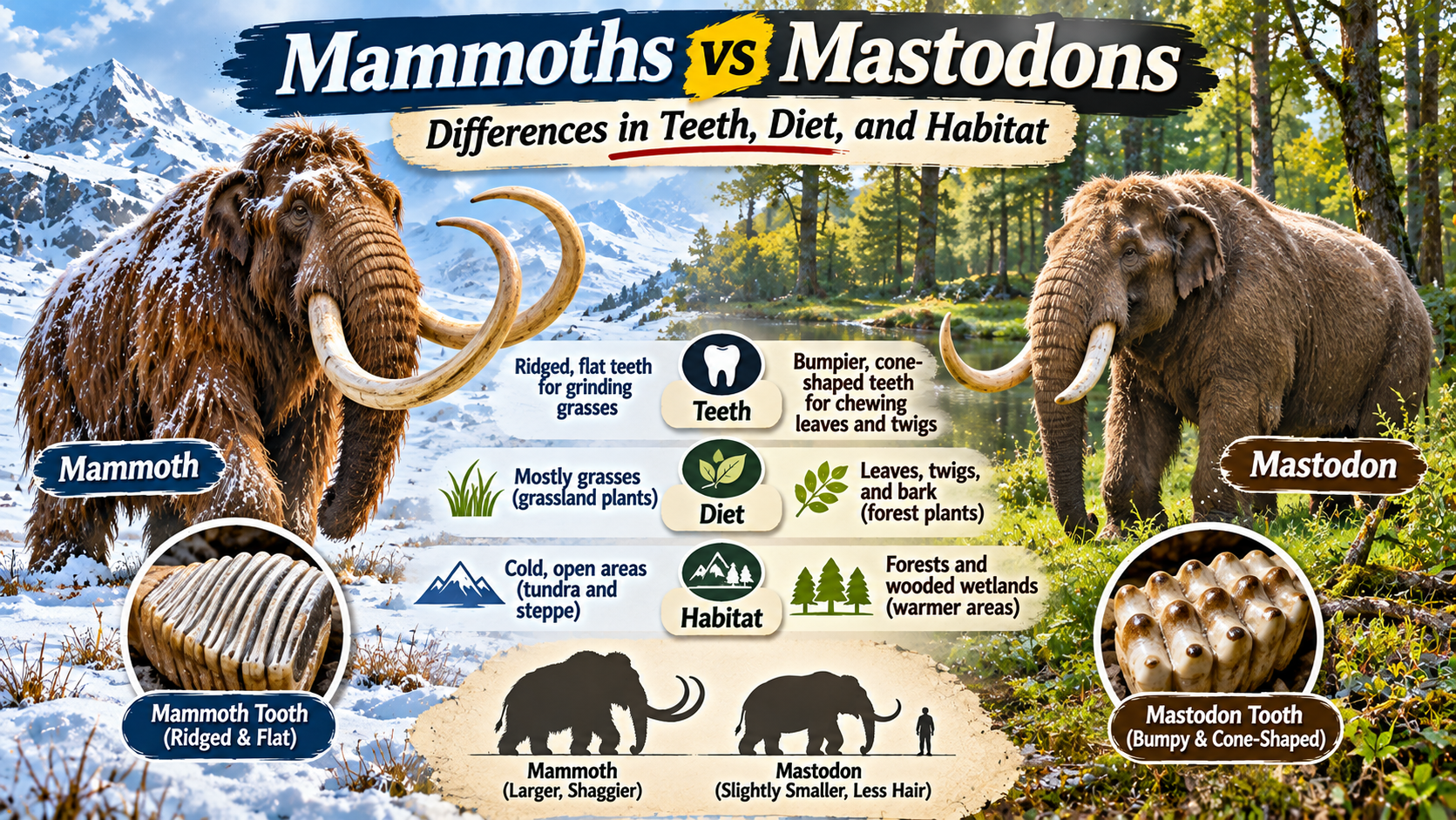
One of the clearest distinctions can be found in their teeth. Mammoths developed broad grinding surfaces suited to processing abrasive vegetation, while mastodons possessed prominent tooth cusps useful for crushing and cutting woody plants.
These dental differences provide valuable clues about how the animals lived.
By combining fossil teeth, preserved stomach contents, plant remains, and geological evidence, paleontologists can reconstruct the ecological roles of these remarkable Ice Age giants.
What Were Mammoths and Mastodons?
Mammoths and mastodons belonged to the mammalian order Proboscidea, which also includes living elephants.
Although they shared a distant common ancestry, mammoths and mastodons followed separate evolutionary paths.
Mammoths belonged to the genus Mammuthus, within the elephant family Elephantidae.
They were more closely related to living elephants than mastodons were.
The American mastodon, Mammut americanum, belonged to the extinct family Mammutidae.
Mastodons were part of an older evolutionary branch that separated from the lineage leading to elephants and mammoths millions of years earlier.
Both groups lived during portions of the Ice Age, but they were not simply different names for the same animal.
Their evolutionary histories help explain why they developed different feeding adaptations.
SPECIMEN A
Mammoth
Genus: Mammuthus
Family: Elephantidae
Typical feeding: Grazing or mixed feeding, depending on species and habitat.
SPECIMEN B
Mastodon
Representative: Mammut americanum
Family: Mammutidae
Typical feeding: Browsing on woody vegetation and other plants.
The Biggest Difference: Mammoth Teeth vs. Mastodon Teeth
Fossil teeth are among the most useful tools for distinguishing mammoths from mastodons.
Teeth often survive long after other parts of an animal’s skeleton have disappeared.
They also reveal information about the kinds of food an animal was adapted to process.
Mammoth Teeth: Built for Grinding
Mammoths possessed large molars containing many closely spaced enamel plates.
These plates formed broad grinding surfaces that helped break down tough vegetation.
The arrangement was particularly effective for processing grasses and other plants containing abrasive particles.
As a mammoth chewed, its teeth wore down through repeated contact with plant material.
The enamel ridges helped maintain functional grinding surfaces despite substantial wear.
Different mammoth species had different dental characteristics, reflecting their evolutionary histories and environments.
Woolly mammoths are especially associated with diets rich in grasses and other low-growing vegetation.
Mastodon Teeth: Built for Crushing
Mastodon molars looked very different.
Instead of numerous parallel enamel plates, they had prominent, rounded cusps arranged in rows.
These raised structures helped crush and shear leaves, twigs, and other woody plant material.
The name mastodon historically referred to the nipple-like appearance of these tooth cusps.
For paleontologists, the difference between mammoth and mastodon molars is often more informative than overall body shape.
A single well-preserved molar may provide strong evidence for identifying which group an animal belonged to.
MUSEUM IDENTIFICATION GUIDE
Look at the Molars Before Looking at the Tusks.
Mammoth: Numerous closely packed enamel plates create a ridged grinding surface.
Mastodon: Large, rounded tooth cusps form a surface suited to crushing and shearing vegetation.
How Their Diets Were Different
Although both animals were herbivores, they generally used different feeding strategies.
These strategies are commonly described as grazing and browsing.
Mammoths as Grazers
Many mammoths, particularly woolly mammoths, relied heavily on grasses, sedges, and other low-growing plants.
These foods were abundant in many open Ice Age environments.
The animals’ grinding teeth were well suited to processing large quantities of fibrous vegetation.
However, mammoth diets were not identical across every species or location.
Some mammoths consumed a mixture of grasses, herbs, shrubs, and other available plants.
Diet could change with climate, season, and habitat.
Mastodons as Browsers
American mastodons generally preferred vegetation associated with forests and wetlands.
Their diets included leaves, twigs, branches, and other plant material.
They could also consume plants growing near lakes, streams, and marshy environments.
Their cusped molars were well adapted to breaking down this type of vegetation.
Evidence from preserved plant material and chemical studies of fossil remains supports the interpretation of mastodons as primarily browsing animals.
Nevertheless, their diets could vary according to local conditions.
Where Mammoths Lived
Mammoths occupied a variety of environments across different periods and regions.
Woolly mammoths are strongly associated with the cold, open landscapes of northern Eurasia and North America.
These environments included extensive grasslands and tundra-like vegetation communities.
Scientists often describe the broader ecosystem as the mammoth steppe.
It supported large herbivores adapted to seasonal cold and relatively open vegetation.
However, not every mammoth lived in a frozen landscape.
Columbian mammoths inhabited much of North America, including regions with milder climates.
Some mammoth populations occupied grasslands, parklands, and other habitats.
This diversity is important because the popular image of a woolly mammoth walking through snow represents only part of mammoth evolutionary history.
Where Mastodons Lived
American mastodons are commonly associated with wooded environments.
Fossil evidence indicates that they inhabited forests, forest margins, and wetlands across parts of North America.
These landscapes offered the leaves, branches, and other vegetation suited to their browsing habits.
Mastodon remains have been discovered in areas that were once associated with lakes and marshes.
Wetland sediments can also create favorable conditions for preserving bones and plant material.
As a result, some discoveries provide unusually detailed evidence of the environments in which mastodons lived.
Although mastodons are often contrasted with open-country mammoths, habitat boundaries were not always absolute.
Both groups could occupy regions containing different vegetation types.
RECONSTRUCTED ICE AGE LANDSCAPES
Many mammoths were adapted to landscapes dominated by grasses, sedges, and other low-growing plants.
American mastodons commonly occupied environments containing trees, shrubs, and wetland vegetation.
Differences in Body Shape and Appearance
Mammoths and mastodons shared many elephant-like characteristics, including large bodies, trunks, and tusks.
However, skeletal evidence reveals differences in their proportions.
Many mammoths had a relatively high shoulder region and a sloping back profile.
Woolly mammoths also possessed adaptations associated with cold environments, including dense hair and substantial fat reserves.
American mastodons generally had a stockier appearance, with a back profile that was often less dramatically sloped.
Both groups could be enormous, although body size varied by species, sex, age, and environmental conditions.
Some mammoth species were considerably larger than the woolly mammoth commonly depicted in popular illustrations.
Because soft tissues rarely fossilize, reconstructions of appearance rely on a combination of skeletal evidence and exceptional preserved specimens.
Mammoths vs. Mastodons: Comparison Table
| Feature | Mammoths | American Mastodons |
|---|---|---|
| Scientific classification | Mammuthus, Elephantidae | Mammut americanum, Mammutidae |
| Molars | Closely spaced enamel plates | Large rounded cusps |
| Primary feeding style | Often grazing or mixed feeding | Primarily browsing |
| Common foods | Grasses, sedges, herbs, and some shrubs | Leaves, twigs, branches, and other plants |
| Typical habitat associations | Grasslands, steppe, and varied open habitats | Woodlands, forest margins, and wetlands |
| Relationship to elephants | Members of the elephant family | More distantly related proboscideans |
| Geographic distribution | Different species across Eurasia, Africa, and North America | North America |
What Fossil Teeth Reveal About Ancient Ecosystems
Teeth do more than help scientists identify extinct animals.
They also provide evidence of ecological relationships.
The structure of a mammoth’s molars reflects adaptation to processing abrasive vegetation.
The cusped teeth of mastodons indicate a different mechanical approach to breaking down food.
Researchers can examine microscopic tooth wear to investigate feeding patterns.
They may also study stable isotopes preserved in tooth enamel to learn about diet and environmental conditions.
These methods are especially valuable when combined with fossil pollen, plant remains, and sediment records.
Together, the evidence helps reconstruct ancient landscapes and understand how large herbivores interacted with vegetation.
However, tooth shape alone cannot reveal every plant an animal consumed.
Detailed dietary reconstructions require multiple sources of evidence.
Did Mammoths and Mastodons Live at the Same Time?
Yes. Mammoths and mastodons coexisted in parts of North America during the Pleistocene Epoch.
Although they sometimes occupied overlapping geographic regions, their different feeding preferences may have reduced direct competition for food.
Mammoths often relied heavily on grasses and other low-growing vegetation.
Mastodons generally consumed more woody plants.
This ecological separation is an example of resource partitioning, in which different species use different portions of the available food resources.
However, scientists should not assume that the animals never competed.
Local vegetation, seasonal conditions, and population distributions could influence how their diets overlapped.
Why Did Mammoths and Mastodons Become Extinct?
The disappearance of mammoths and mastodons remains an important topic in Ice Age research.
Many mainland populations vanished near the end of the Pleistocene, during a period of major environmental change and expanding human activity.
Climate shifts altered vegetation communities and transformed habitats.
At the same time, humans were present in regions occupied by large Ice Age mammals.
Researchers continue investigating the relative importance of climate change, hunting pressure, population vulnerability, and other ecological factors.
The causes may have differed between species and regions.
Some isolated woolly mammoth populations survived much longer than mainland populations.
For example, mammoths persisted on Wrangel Island in the Arctic until approximately 4,000 years ago.
This extended survival demonstrates that extinction did not occur everywhere at the same time.
How Scientists Study Mammoths and Mastodons Today
Modern paleontology combines traditional fossil research with advanced scientific techniques.
Researchers examine skeletons and teeth to reconstruct anatomy and evolutionary relationships.
Microscopic wear patterns help investigate diet.
Stable isotope analysis provides information about feeding ecology and environmental conditions.
Radiocarbon dating can help establish the ages of suitable late-Pleistocene remains.
Ancient DNA studies have also provided important insights into mammoth populations, their relationships, and aspects of their evolutionary history.
Exceptional discoveries sometimes preserve hair, skin, or other soft tissues, particularly in frozen environments.
These findings help scientists move beyond simple descriptions of prehistoric animals toward more detailed reconstructions of their lives.
Frequently Asked Questions
Are mammoths and mastodons the same animal?
No. They belonged to different evolutionary groups within Proboscidea and had distinct teeth, feeding adaptations, and typical habitat preferences.
What is the easiest way to tell their fossils apart?
The molars are particularly useful. Mammoths had teeth with many enamel plates, while mastodons had teeth with prominent rounded cusps.
Did mastodons eat grass?
They may have consumed various plants, but fossil evidence indicates that American mastodons were primarily browsers rather than specialized grazers.
Were all mammoths covered in thick wool?
No. Woolly mammoths were adapted to cold environments, but other mammoth species lived in different climates and did not necessarily share the same coat characteristics.
Did mammoths and mastodons live together?
Yes. Both groups lived in parts of North America during the Pleistocene, although they often used different food resources and habitats.
Which animal was more closely related to modern elephants?
Mammoths were more closely related to living elephants because they belonged to the same family, Elephantidae.
When did mammoths become extinct?
Most mainland mammoth populations disappeared near the end of the last Ice Age, but isolated populations survived longer, including those on Wrangel Island until about 4,000 years ago.
Final Thoughts
Mammoths and mastodons were two remarkable groups of prehistoric mammals that shared an elephant-like appearance but occupied different ecological roles.
The most revealing differences appear in their teeth.
Mammoths developed ridged molars suited to grinding vegetation, while mastodons possessed cusped molars adapted to crushing and shearing woody plants.
These dental adaptations corresponded with broader differences in feeding behavior and habitat preferences.
Many mammoths occupied open grasslands and steppe environments, while American mastodons were commonly associated with forests and wetlands.
By studying fossil teeth, bones, preserved plants, and ancient environmental evidence, paleontologists continue to reconstruct the lives of these Ice Age giants.
Their differences illustrate how closely related-looking animals can evolve distinct strategies for surviving in changing environments.