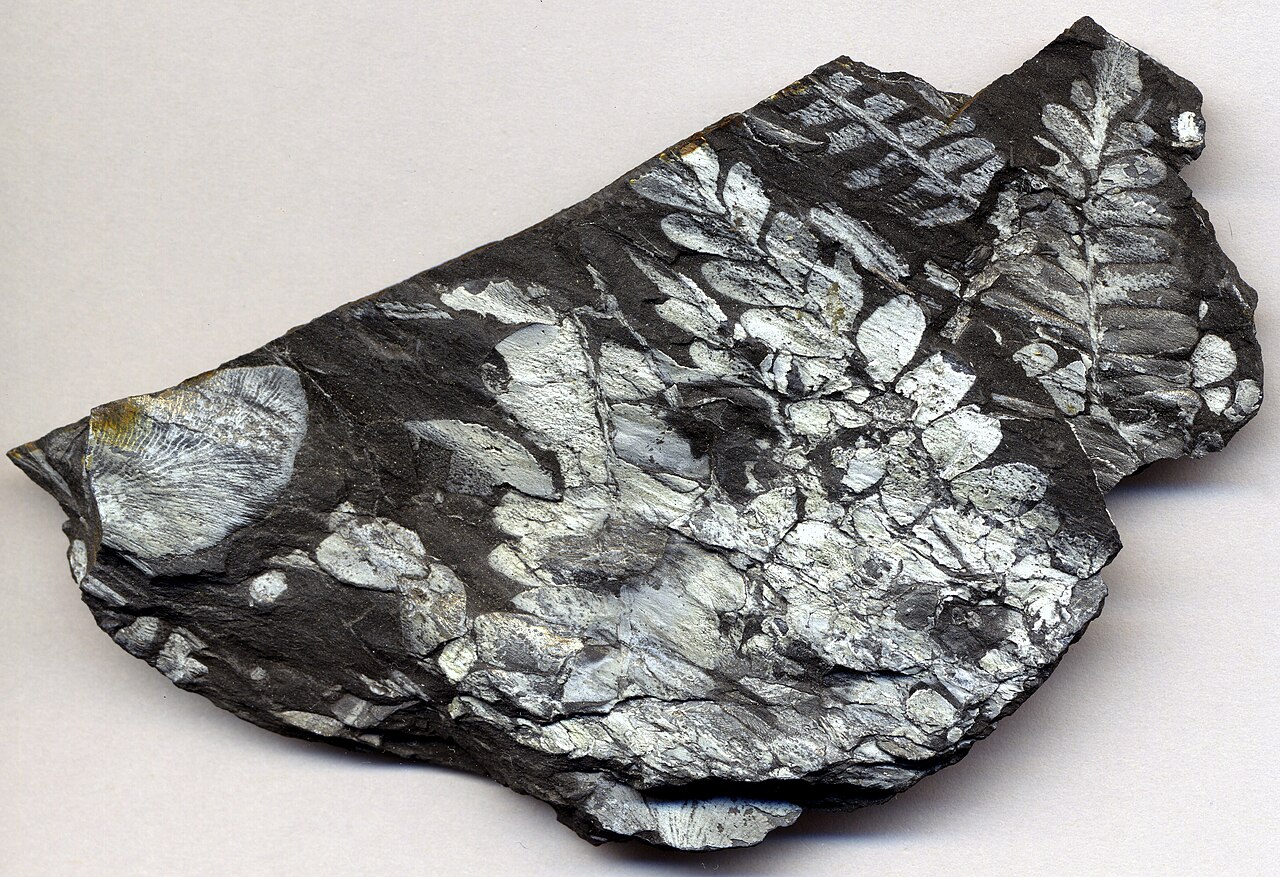
While heavy skeletal bones and petrified mineral logs command grand museum galleries, some of the most delicate evolutionary breakthroughs in paleontology are preserved not as three-dimensional stone replicas, but as gossamer-thin, pitch-black silhouettes etched onto sedimentary shale. This is the realm of carbonization — also referred to by taphonomists as distillation or carbon compression. Through geological burial, intense lithostatic overburden pressure, and geothermal heat, the volatile hydrogen, oxygen, and nitrogen components of an ancient organism are systematically driven away, leaving behind a stable, two-dimensional residue of elemental carbon. From the delicate leaves of Carboniferous coal swamps to the soft bodies of Burgess Shale arthropods and feathered dinosaurs, carbonization preserves the fine, soft textures of deep time.
Executive Takeaway: The Carbon Silhouette
Carbonization occurs when organic remains are compressed beneath sedimentary layers in anoxic conditions. As temperature and pressure escalate, volatile elements (water, methane, carbon dioxide, ammonia) are distilled away, leaving behind an ultra-thin black film of pure elemental carbon that replicates the soft anatomy, epidermal cuticles, feathers, and outlines of ancient organisms.
The Chemical Mechanics of Pyrolysis and Carbonization
All living organisms are fundamentally carbon-based chemical machines. Soft biological tissues — such as plant cell walls, insect exoskeletons, muscle fibers, and skin — are composed of high-molecular-weight organic polymers: cellulose, lignin, chitin, proteins, and keratin. These molecules are dense with carbon, hydrogen, oxygen, nitrogen, and sulfur.
When an organism is buried in fine-grained mudstone or shale under oxygen-deficient conditions, the stage is set for geochemical distillation:
1. Compaction and Dehydration
As hundreds of meters of sediment accumulate overhead, vertical lithostatic pressure increases exponentially. Pore waters are expelled from the surrounding mud, and the three-dimensional organism is compressed vertically into a flattened, two-dimensional plane along the sedimentary bedding plane.
2. Thermal Maturation and Volatilization
Subjected to the geothermal gradient (temperatures rising between 50°C and 150°C in the deep diagenetic zone), weak chemical bonds break down. The volatile components of the organic molecules — hydrogen, oxygen, and nitrogen — recombine into volatile gases: water vapor (H2O), carbon dioxide (CO2), methane (CH4), and ammonia (NH3). These gases escape through porous micro-fissures in the rock.
3. Elemental Carbon Condensation
Because carbon has an exceptionally high thermal stability and forms strong covalent carbon-carbon double bonds, it resists volatilization. The carbon atoms condense into polycyclic aromatic hydrocarbon sheets — essentially a micro-thin layer of graphite-like elemental carbon. This black or dark brown carbonaceous film remains permanently adhered to the rock surface, preserving a high-contrast, photographic silhouette of the organism.
| Preservation Mechanism | Typical Organisms Preserved | Primary Sediment Matrix | Preserved Morphological Detail |
|---|---|---|---|
| Carbonization (Carbon Film) | Fern fronds, glossopterids, soft-bodied worms, fish, feathers | Fine black shale, laminated siltstone, lithographic limestone | Cellular leaf venation, stomata, body outlines, feather barbules |
| Coalification (Bulk Carbonization) | Massive peat accumulations (Lepidodendron, Sigillaria) | Coal seams (Lignite → Bituminous → Anthracite) | Macro-botanical strata; compressed tree trunks, stigmarian roots |
| Permineralization | Wood, vertebrate bones, marine shells | Sandstones, conglomerates, porous limestones | 3D cellular voids filled with silica or calcite crystals |
| External Mold | Shelled mollusks, brachiopods, trilobites | Coarse sandstones, dolomites | Negative surface impression; original material dissolved |
The Carboniferous Coal Forests: Planet-Scale Carbonization
The most monumental manifestation of carbonization in Earth’s history occurred during the Carboniferous Period (approximately 359 to 299 million years ago). Across equatorial Pangea, vast, dense tropical swamp forests flourished, dominated by colossal clubmosses (Lepidodendron reaching 130 feet tall), giant horsetails (Calamites), and early seed ferns.
When these ancient trees died and fell into stagnant, acidic swamp waters, low oxygen levels and high concentrations of antimicrobial lignin prevented fungal and bacterial decay. Peat layers accumulated tens of meters thick. Over millions of years, as tectonic subsidence buried these peat basins beneath thousands of feet of clastic sediment, geological heat and pressure drove out moisture and volatile hydrocarbons through progressive coalification: transforming peat into lignite, then bituminous coal, and ultimately hard anthracite. The burning of coal today is literally the combustion of ancient solar energy stored within Carboniferous plant cells over 300 million years ago.
Mazon Creek: Carbonaceous Treasures of the Swamps
In the Pennsylvanian-age Francis Creek Shale of Illinois, the legendary Mazon Creek fossil locality provides one of the world’s greatest carbon film archives. Organisms were buried in rapid deltaic mud events, which triggered the localized precipitation of siderite (iron carbonate, FeCO3) concretions around the carcasses. When paleontologists split these hard, nodular concretions open, they discover exquisite, pitch-black carbon film compressions of delicate soft-bodied organisms that exist nowhere else in the fossil record: the bizarre, tooth-tipped proboscis of the “Tully Monster” (Tullimonstrum gregarium), delicate jellyfish silhouettes, and perfectly articulated aquatic polychaete worms.
Modern Micro-Spectroscopy: Chemical Fingerprinting of Ancient Carbon
For decades, paleontologists viewed carbon film fossils merely as visual flat silhouettes. Today, revolutionary analytical technologies have turned carbonization into a goldmine of ancient biochemistry:
- Raman Spectroscopy: Focuses laser light on the carbonaceous film to measure molecular vibrational modes, determining the exact thermal maturity, maximum burial temperature, and graphite ordering of the fossil.
- X-ray Fluorescence (XRF) and Synchrotron Imaging: Maps the chemical distribution of trace metals (copper, zinc, iron) bound within the organic carbon film, revealing the presence of ancient blood pigments, liver residues, and neural anatomy invisible under optical microscopes.
- Pyrolysis-Gas Chromatography-Mass Spectrometry (Py-GC-MS): Thermally degrades microscopic flakes of carbon film to identify surviving biomolecular fragments: ancient biopolymers, cutin waxes from plant leaves, and melanin pigment residues from dinosaur feathers.
Fossil Leaves and Paleoclimatic Stomatal Indices
Carbonized plant leaves provide one of the most critical proxy tools in paleoclimatology. Under high magnification, the carbon film of a fossilized leaf preserves the epidermal cell walls and microscopic breathing pores called stomata, through which plants absorb carbon dioxide (CO2) for photosynthesis.
Botanists established that plants regulate stomatal density in response to atmospheric carbon dioxide: when CO2 is low, plants grow more stomata to capture sparse gas; when atmospheric CO2 is high, plants produce fewer stomata to prevent excessive water loss through transpiration. By measuring the Stomatal Index on carbonized fossil leaves across deep time — such as Ginkgo leaves spanning the Triassic-Jurassic and Cretaceous-Paleogene boundaries — geochemists reconstruct ancient atmospheric CO2 levels, providing critical historical baselines for modern anthropogenic climate models.
Conclusion: The Indestructible Signature of Life
Carbonization proves that under the colossal forces of the Earth’s crust, the most volatile elements of biology can be stripped away while the foundational element of life — pure carbon — remains permanently etched into the stone. These delicate, paper-thin silhouettes preserve the fragile architecture of leaves, insect wings, and ancient soft bodies that could never survive the coarser mechanics of permineralization. In the dark carbon films of shale, deep time leaves its most intimate and delicate autographs.