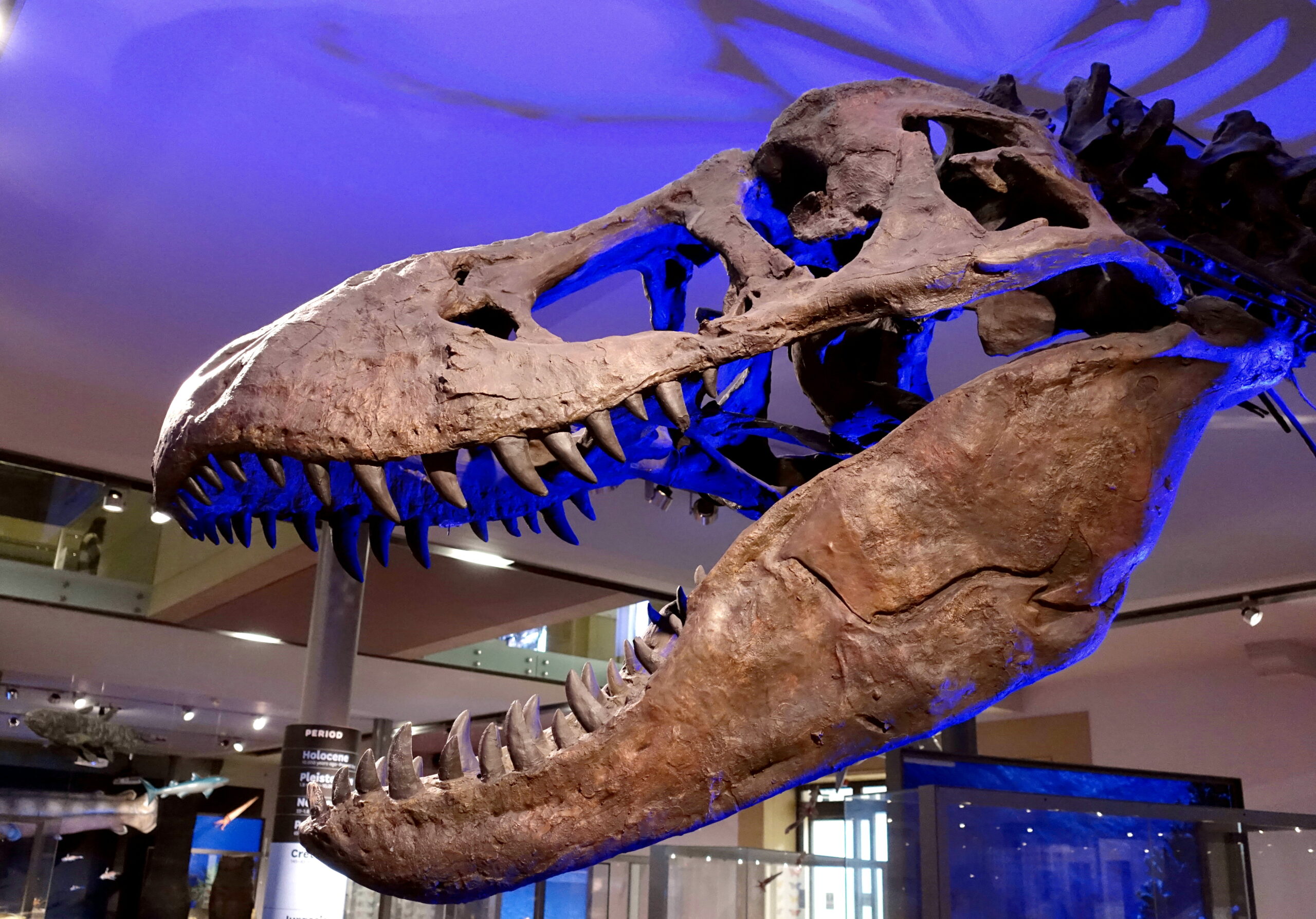
No creature in the 3.8-billion-year chronology of terrestrial life captures the primeval power of the Mesozoic Era quite like Tyrannosaurus rex. Roaming the coastal plains and subtropical river valleys of western North America (Laramidia) during the terminal Cretaceous period (approximately 68 to 66 million years ago), this colossal theropod was among the largest terrestrial carnivores ever to walk the Earth. Measuring over 40 feet in length, standing 12 feet tall at the hips, and tipping the scales at nearly nine metric tons, T. rex was not merely a scaled-up predatory reptile, but a marvel of evolutionary biomechanical specialization. From fused nasal bones and bone-crushing dentition to advanced binocular vision and controversial locomotive speeds, modern paleobiology has transformed our understanding of this iconic apex predator.
Executive Takeaway: The Biomechanical Marvel of T. rex
Tyrannosaurus rex possessed the most devastating terrestrial bite force in animal history (~35,000 to 57,000 Newtons), capable of osteophagy (pulverizing thick ceratopsian and hadrosaurid bones). Powered by a fused, reinforced skull, forward-facing binocular stereoscopic vision, and massive cervical musculature, T. rex operated as a consummate hypercarnivorous apex predator and opportunistic scavenger.
Cranial Architecture: Built for Catastrophic Impact
To understand the predatory capabilities of Tyrannosaurus rex, one must examine its cranial biomechanics. Most carnivorous dinosaurs, such as Allosaurus or Giganotosaurus, possessed relatively narrow, kinetic skulls equipped with blade-like, serrated teeth designed for slicing flesh and inducing massive hemorrhaging — a “slash-and-retreat” hunting strategy.
In contrast, T. rex evolved an entirely different, bone-shattering cranial weapon. The skull of a mature adult (such as FMNH PR2081, “Sue”) measures up to five feet in length and expands dramatically toward the rear, reaching a width of nearly three feet across the temporal region. This wide posterior expansion provided cavernous attachment acreage for monumental jaw-closing muscles — specifically the M. adductor mandibulae externus and the deep pterygoideus muscle complexes.
| Biomechanical Metric | Tyrannosaurus rex (Mature Adult) | Allosaurus fragilis (Late Jurassic) | Modern Saltwater Crocodile (C. porosus) |
|---|---|---|---|
| Estimated Body Mass | 8,000 – 9,500 kg (8.8 – 10.5 tons) | 1,500 – 2,000 kg (1.6 – 2.2 tons) | 1,000 – 1,300 kg (1.1 – 1.4 tons) |
| Maximum Posterior Bite Force | 35,000 – 57,000 Newtons (8,000 – 12,800 lbf) | 3,500 – 8,500 Newtons (780 – 1,900 lbf) | 16,400 Newtons (3,700 lbf) |
| Tooth Morphology | Incisiform premaxilla; stout oval ‘killer bananas’ | Laterally compressed, blade-like ziphodont | Conical piercing teeth (no serrations) |
| Binocular Visual Field | Up to 55 degrees (Exceeding modern hawks) | ~20 degrees (Primarily lateral) | ~25 degrees |
| Cranial Kinesis | Rigid, fused nasals & interlocked frontals | Highly kinetic intra-cranial joints | Akinetic reinforced skull |
Dentition and Bite Force Physics: The Bone-Crushing Specialist
The teeth of T. rex are fundamentally distinct from other theropods. Paleontologists frequently describe them as “lethal bananas.” Reaching up to 12 inches in length including the robust root, their cross-section is not thin and flattened, but thick, rounded, and oval-shaped with heavy front-and-back serrations. This robust morphology prevented teeth from snapping under bending moments when striking dense cortical bone.
Biomechanical computer modeling utilizing finite element analysis (FEA) by Dr. Gregory Erickson and Dr. Karl Bates reveals that T. rex generated posterior bite forces between 35,000 and 57,000 Newtons (roughly 8,000 to 12,800 pounds of force). At the tooth tips, pressure reached an astonishing 431,000 pounds per square inch. This colossal force was absorbed by fused nasal bones and interlocked frontal sutures that dissipated stress across the reinforced cranial vault, allowing T. rex to bite cleanly through the solid pelvises and ribcages of adult Triceratops — a capability verified by fossilized hadrosaur bones bearing deep T. rex puncture marks and fossilized dung (coprolites) composed of over 50 percent pulverized bone shards.
Sensory Superiority: Vision, Olfaction, and Hearing
The sensory apparatus of Tyrannosaurus rex disproved early 20th-century portrayals of theropods as mindless, nearsighted lizards:
- Binocular Depth Perception: The wide skull base angled the eyes directly forward, producing a binocular stereoscopic field of view of 55 degrees — broader than a modern human and rivaling birds of prey.
- Hyper-Developed Olfaction: CT scans of the endocranial cavity reveal immense olfactory bulbs and expansive olfactory tracts, indicating a sense of smell superior to bloodhounds, capable of detecting scents carried across miles of prevailing winds.
- Low-Frequency Hearing: The elongated cochlea within the inner ear was acoustically tuned to register infrasonic, low-frequency rumbles (under 50 Hz), perfect for tracking seismic footfalls and long-distance herd communication.
The Locomotion Debate: Runner, Trotter, or Fast Walker?
Few aspects of T. rex paleobiology have generated as much fierce academic debate as its locomotive speed. Early pop-culture depictions showed the monster pacing a speeding Jeep at 50 mph. However, biomechanical analyses led by Dr. John Hutchinson utilizing musculoskeletal physics demonstrate that an adult nine-ton bipedal dinosaur was physically incapable of true suspended-phase running.
For an animal of that mass to run at 40 mph, more than 80 percent of its total body muscle mass would need to be concentrated exclusively in its legs — an anatomical impossibility. Bone stress simulations show that the immense torsional and compressive loads generated during a fast sprint would have fractured the femur and tibia. Current scientific consensus places the maximum locomotive speed of an adult T. rex at approximately 12 to 17 mph (20 to 27 km/h), achieved via an elongated, power-efficient, grounded fast-walk. While modest compared to modern racehorses, this speed was comfortably faster than the giant ceratopsians and armored ankylosaurs that constituted its primary prey.
The Predator vs. Scavenger Controversy: Horner’s Fallacy Resolved
In the 1990s, paleontologist Jack Horner popularized the provocative hypothesis that T. rex was an obligate scavenger — a Mesozoic hyena or vulture — pointing to its tiny two-clawed arms, massive olfactory bulbs, and bone-cracking teeth as adaptations meant solely for consuming abandoned carcasses.
While captivating for debate, the “obligate scavenger” hypothesis has been decisively refuted by direct paleontological evidence:
- Healed Bite Marks on Prey: Several hadrosaurid (duck-billed dinosaur) specimens exhibit severe T. rex bite injuries to their tail vertebrae that healed and remodeled over months of subsequent life — definitive proof that the dinosaur attacked living prey that escaped and survived.
- Embedded Tooth in Edmontosaurus: In 2013, researchers described a fused, infected tail vertebra of an adult Edmontosaurus with a broken T. rex tooth crown completely surrounded by healed bone growth, providing an indisputable forensic smoking gun of active predation.
- Ecological Energetics: Trophic food-web modeling demonstrates that an ecosystem cannot sustain a pure terrestrial scavenger of nine tons; obligate scavengers in modern ecosystems (like vultures) must fly long distances on thermal updrafts to locate scarce carcasses with minimal energy expenditure. A ground-bound biped could never survive purely on serendipitous carrion.
Conclusion: The Consummate Hypercarnivore
The modern scientific portrait of Tyrannosaurus rex reveals an apex predator of supreme evolutionary refinement. Like modern apex carnivores — lions, wolves, and spotted hyenas — T. rex was an opportunistic hypercarnivore: it stalked, ambushed, and overpowered living prey with bone-crushing violence when hunting, and enthusiastically scavenged fresh carcasses when available. Combined with exceptional sensory intelligence, formidable stereoscopic vision, and unmatched bite physics, Tyrannosaurus rex earned its scientific crown as the undisputed tyrant lizard king of the prehistoric world.